Project
Aims and Overview
Fuel burning and the chemical industry in general have taken a prominent role in human society over the last centuries. To keep and expand human wellbeing without greenhouse gas emissions and the destruction of scarce resources requires the defossilization of the chemical industry. Indeed, energy-intensive industrial processes and heavy transport are responsible for about 40% of global energy consumption.
These sectors use fossil resources both as feedstock for raw materials and as energy-dense fuels. Unlike the case in other sectors of energy consumption, these elements are not directly replaceable by renewable electricity.
It is thus crucial to produce energy-rich and chemically-useful molecules (e.g. CO, H₂, NO, C₂H₄) in large quantities from abundant base molecules (e.g., H₂O, N₂, CO₂) and intermittent renewable energy. These products can subsequently be used as elementary building blocks for the conversion into hydrocarbon fuels and complex chemicals.
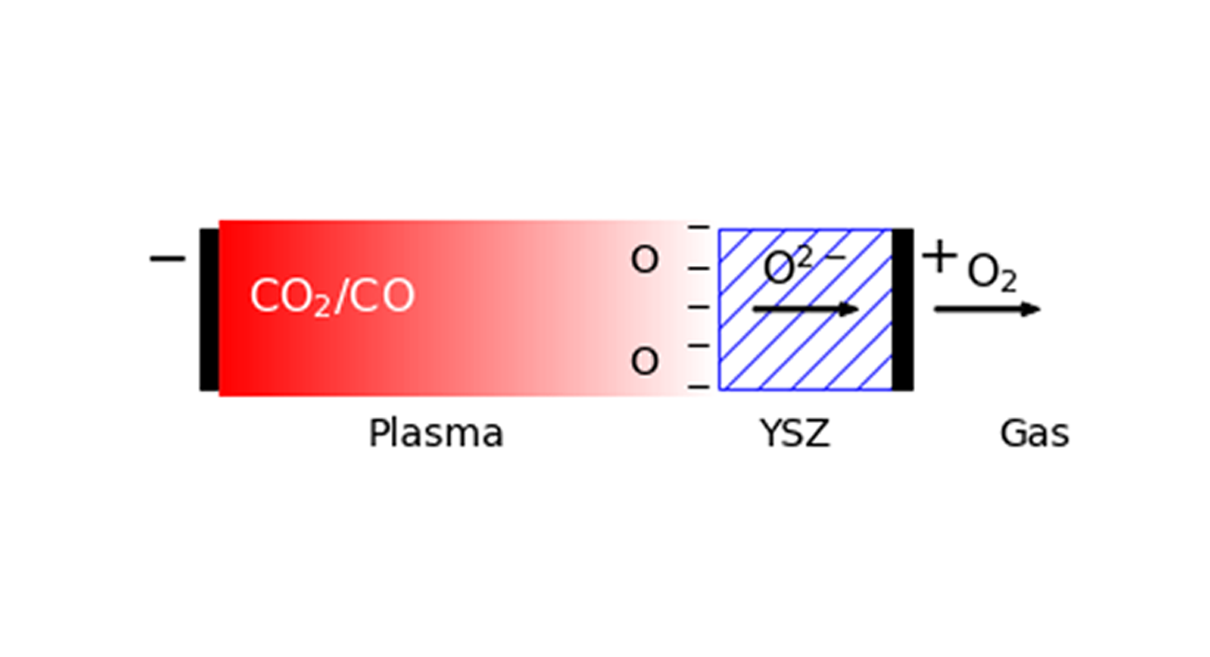
Project SYAMESE proposes to use an all-electric route for conversion of base molecule CO₂ into chemically-useful CO and O₂.
A highly novel approach to electro-synthesis will be studied by merging two developing technologies: oxygen-conducting membranes used in solid oxide electrolysis and plasma conversion. In this way the reactivity of the plasma will be synergistically combined with the selectivity of electrolysis.
This project proposes an all-electric technological solution with direct separation of conversion products CO and O₂, high durability and output, by using the plasma as cathode of the SOEC, thus replacing metallic electrodes that suffer from degradation through oxidation. It will assess a simplified reactor and, for the first time, study the fundamental processes within the merged plasma-SOEC electrochemical cell.
The team of this project, via an international collaboration between IPFN and LPP, has extensive expertise in numerical modelling of plasmas, surface kinetics and experimental diagnostics. In recent years, it has played a leading role in developing electrochemical conversion technologies using plasmas. The team is in an excellent position to address the challenges of plasma-SOEC coupling and to take the SYAMESE project beyond the state-of-the-art, laying the foundation for a proof-of-concept plasma-membrane system for CO₂ conversion based on fundamental understanding.
To understand the synergies between plasma and ion-conducting membranes, the project is organized into 3 key tasks:
Development of a plasma-membrane fluid model
Describing the production and transport of species in the plasma and of O₂⁻ in the YSZ membrane, within experimental reactor conditions.
Self-consistent coupling of the fluid model
With microscopic descriptions of plasma-surface kinetics and surface charging at the membrane interface. Numerical simulations will reveal the fundamental interactions between plasma and SOEC.
Experimental validation
Installation of a plasma-SOEC set-up and use of diagnostics to measure plasma and membrane surface parameters, as well as CO and O₂ yields, validating the model.